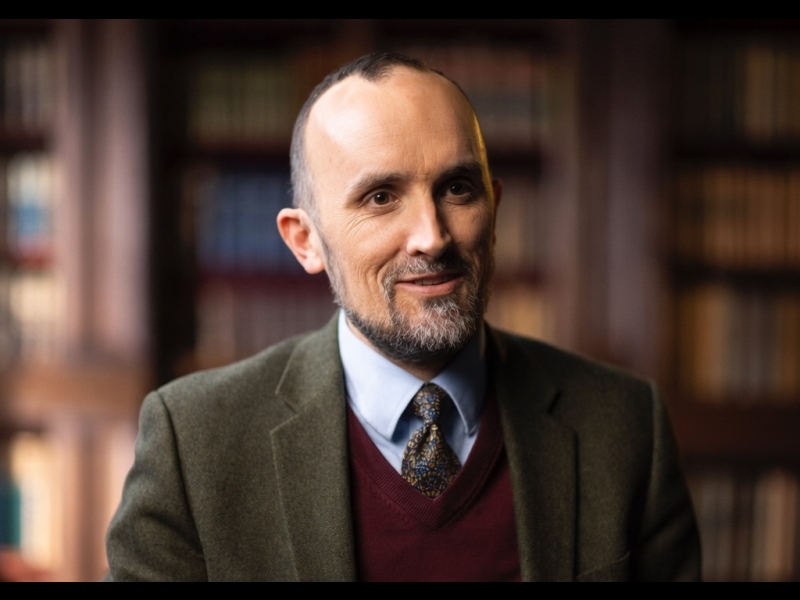
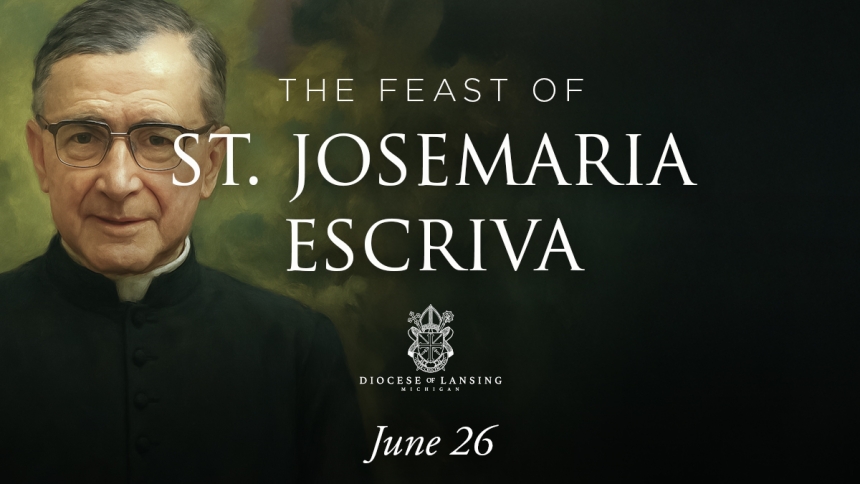
Saint Josemaría Escrivá (1902-1975) is the twentieth century’s great saint of the Laity, and of Everyday Life, writes Dr. Dwight Lindley, pictured below, Associate Professor of English at Hillsdale College. In many ways, he was an ordinary citizen of twenty-first-century Europe, the son of middle-class parents in a country that would soon be threatened by war, and his life follows the contours of many other saints: raised in a Catholic family, he received a call from God as a young man, which then grew and matured over the course of his life, burgeoning into a Catholic institution that spanned the globe.
But in other respects, Saint Josemaría’s life was distinctive and remarkable. His call, on October 2, 1928, was to “promote among people of all classes of society the desire for Christian perfection in the midst of the world,” no matter where they lived or worked. In other words, he saw that day that God wanted him to open up a path to holiness in the middle of the everyday lives of the laity, something that Catholics had not adequately appreciated, perhaps since the age of the early Church. At the time, Father Josemaría was a young diocesan priest in Madrid, Spain, but he began to see that he would need to organize an apostolate much bigger than any one parish, crossing the lines of countries throughout Europe, then the world.
As he was beginning to gather the first members of Opus Dei (Latin for “the Work of God”), Saint Josemaría found himself caught in the middle of the Spanish Civil War (1936-1939), which threatened the life of his movement and its members. With tremendous heroism, Escrivá and his followers stayed alive during that violent time, keeping their fledgling group hopeful and faithful through it all. Indeed, it is a testament to the grace of Saint Josemaría’s founding that so many of his followers remained with him, in person or in spirit, through the war, only growing stronger through the suffering.
The attractive power of Father Josemaría’s message came from the fact that he traced out a Way (the title of his first great book) for working men and women to make their way toward Heaven, while remaining in the midst of the world. Spanish Catholicism was a notably “clerical” culture at the time, emphasizing the vocations to priesthood and religious life, but neglecting the lives of the lay majority: here was where Saint Josemaría made his appeal — “this is God’s will for you, your sanctification” — and many were hungry for that new way of life. First in Spain, then in many other countries after the War, he organized the formation of lay men and women, preaching retreats, giving spiritual direction, and raising up others to help him do this work. What came to be called “the Work” grew quickly.
During the second half of his life (1946-1975), Escrivá relocated to Rome, where he would direct the global growth of Opus Dei, oversee the formation of a new society of priests (the Priestly Society of the Holy Cross) who would serve its lay members, and work with the Vatican to define Opus Dei’s place in the Church. Among other things, he indirectly influenced (through his right-hand man, Blessed Álvaro del Portillo) the Second Vatican Council’s teaching on the Universal Call to Holiness, and the vocation of the Laity. Through him, God has opened up “a way of sanctification in daily work, and in the fulfillment of the Christian’s ordinary duties,” inspiring us to realize that every moment of our lives in the world is a place to meet God.