
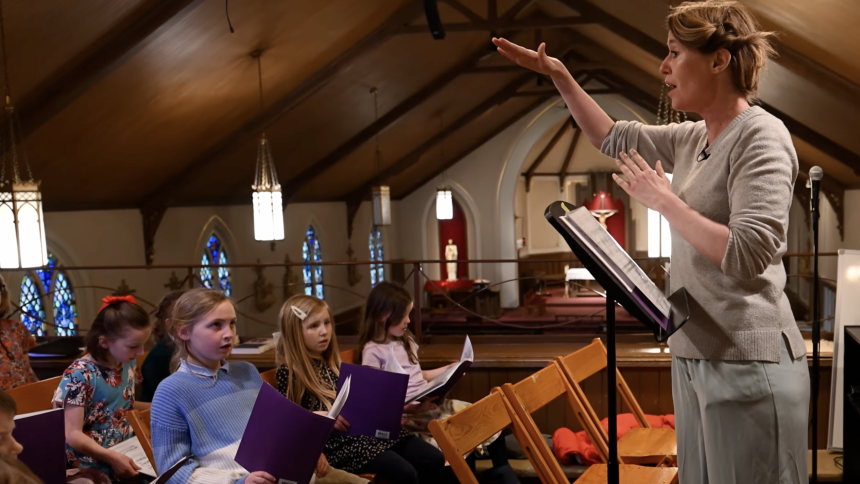
The children of Saint Anthony in Hillsdale seem to be growing in their love and learning of Gregorian chant. Watch this short film to find out for yourself!
“I grew up singing in a liturgical choir that sang Gregorian chant," explains Schola Leader, Catherine Kuiper, pictured above, "and, so, I had the memory of singing chant as a little kid and knew that it was possible and, so, I wanted to see how easy or difficult it would be to recreate that experience.”
The Saint Anthony junior schola was established last fall. Since then, Catherine has tutored the youthful choir with the help of parish Music Director, Anne Schmitt.
So what is Gregorian Chant? Gregorian Chant takes its name from Pope Saint Gregory the Great (c. 540 – 604). Among the many achievements of his papacy, Gregory revised the Roman Rite of the Mass and established a more uniform standard of music in church services, gathering chants – monophonic, unaccompanied sacred songs – from various regional traditions with the aim of organizing them into a more orderly whole for use by the entire Western Church. In posthumous recognition of his endeavors, this form of church music was later styled “Gregorian chant”.
The Second Vatican Council (1962 – 65) taught that “Gregorian chant, as proper to the Roman liturgy, should be given pride of place, other things being equal. Its melodies, contained in the 'typical' editions, should be used, to the extent that this is possible,” adding that “Above all, the study and practice of Gregorian chant is to be promoted, because, with its special characteristics, it is a basis of great importance for the development of sacred music.”