
Friday, February 27, 2026
Friday of the First Week of Lent
Dear Sisters and Brothers in Christ,
Welcome to my seventh installment of our exploration of Saint Paul's dealings with the first century Church in the city of Corinth in southern Greece. Various issues which Paul faced in evangelizing and then shepherding this community are really not much different from those we face today. Hence, it is well worth our efforts to examine more closely this sister Church to determine how we might better be the Church that Jesus calls us to be. Today: Spiritual Gifts.
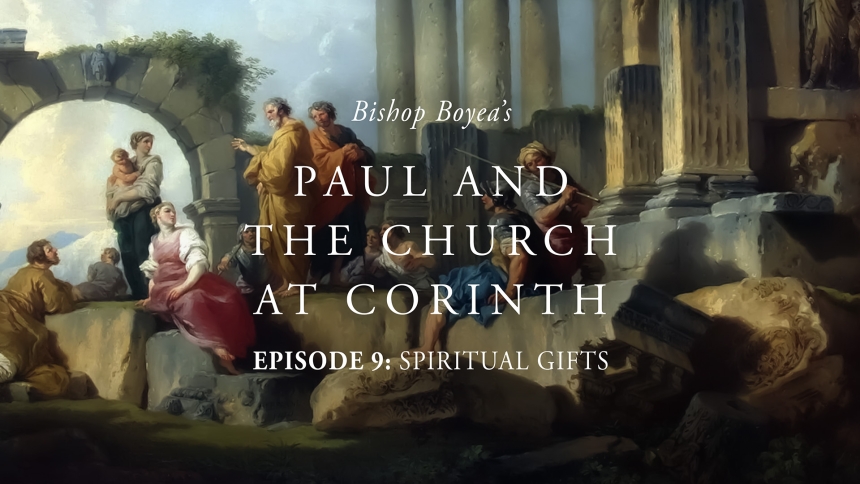
Episode 9: Spiritual Gifts (1 Corinthians Chapter 12-14)
The real issue for Paul concerning this matter is something that affects every community: who is superior to whom. Paul responds with the principle that there is diversity and yet there is unity, and these do not contradict one another. As soon as we use diversity to pit one against another, we have lost unity. On the other hand, unity does not mean sameness. The real source of this unity and diversity is the one Spirit of God who distributes all gifts for the common good. The Spirit as the source of all unity and diversity is made clear in the statement which only the Spirit can prompt us to say, “Jesus is Lord.” The Spirit is mentioned 8 times in these first eleven verses.
The real foundation for this teaching is unique to Paul. He is the only New Testament writer to use the image of the body to describe the Christian community. I have always been fascinated by verse 12 of chapter 12: “As a body is one though it has many parts, and all of the parts of the body, though many, are one body, so also Christ.” I am always taken aback by the final word, “Christ.” I would expect here the words, “the Church.” Yet, Paul is clear. He is speaking of the Body of Christ. And it is Christ’s own body of which we are parts, forming a unity with Christ.
Now Paul will pick up the practical conclusions of this teaching in Chapter fourteen. However, he interrupts his argument, or better, he solidifies his argument, with Chapter thirteen, the finest writing Paul has given us. Here he writes of love. One aspect of the charm of this section is that Paul does not issue this matter as a commandment. Rather, love is a gift. This divine gift prepares us for that day when we and Paul shall be fully known and see the divine love face to face. And this love seemingly manifests itself in very practical ways. In the face of all the divisions Paul has encountered in Corinth and, no doubt, in every Church he established, living out love leads us to the next life.
Finally, in chapter fourteen, Paul tackles the issue of speaking in tongues which must have been a point of contention for that early community. No doubt, Paul himself spoke in tongues, and this may have led to some form of competition among the Corinthians. Paul, however, makes it clear that, at least in the assembly, tongues are not helpful if they do not lead to understanding by everyone else. Certainly, praising God in tongues is a good thing, but in the assembly the aim must be to build up the whole body, and one needs understanding for this to take place. It is the only way for the members to proclaim, “Amen,” to what has been said.
But Paul makes another point in this chapter and that is his call for order in the worshipping assembly. Recall again that these meetings took place in private homes which were, however, often open to the public. What may be good for private spirituality could offend others in a public or quasi-public gathering. Verses 34-35 about women in the assembly have been variously and rather unsuccessfully understood. Was Paul cautioning the Christian community where women were equals and could be prophets and teachers to be careful in the presence of others or was he concerned that these women were causing disorder or speaking up in a chaotic way? These seem like strange verses and are contradicted by what is said in other places, so we are left unsure of their intended meaning and purpose.
The key for the Christian assembly is to do all in love, for the upbuilding of one another and of the Body of Christ, and to make sure that an orderly manner of worship is followed. God “is not the God of disorder but of peace” (14:33). Saint John Chrysostom, in his Homilies on I Corinthians (36.8), reports on such disorder even in his own times: "But here great is the tumult, great the confusion, and our assemblies differ in nothing from a vintner’s shop, so loud is the laughter, so great the disturbance….for the church is no barber’s or perfumer’s shop, nor any other merchant’s warehouse in the market-place, but a place of angels….so neither here ought one to utter any other sound but these which are spiritual."
Until next week, may God bless you.
+ Earl Boyea
Bishop of Lansing
P.S. Here is a video version of this week's talk. Please do share with friends and family. Thank you.