
Friday, February 13, 2026
Friday of the Fifth Week of Ordinary Time
Dear Sisters and Brothers in Christ,
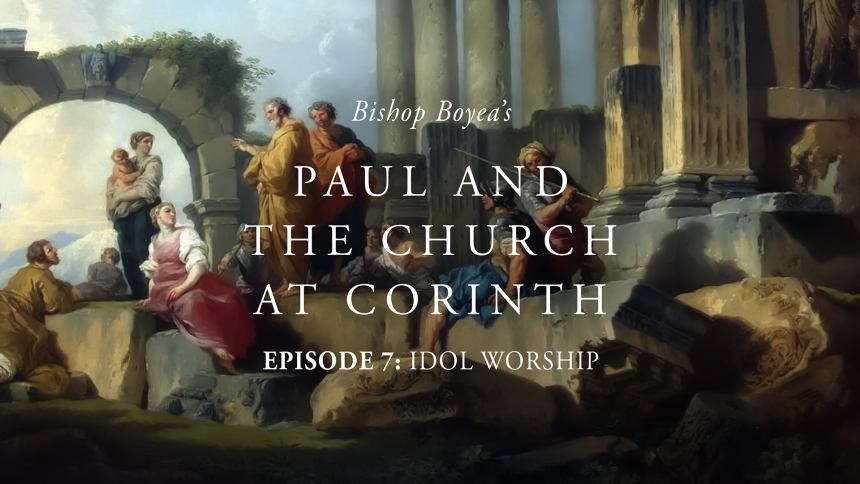
Today, in this seventh talk, we move on to another question Saint Paul posed by the Corinthians: Idol worship.
Episode 7: Idol Worship (1 Corinthians, Chapters 8-10)
At first sight chapters eight through ten (1 Corinthians) may seem to the modern reader as not very pertinent to our times. After all, we don’t have animals being sacrificed to idols and then being served at our meals or restaurants or in our marketplaces. This was the practice at Paul’s time and the Jews and Christians living in Corinth had to deal with this matter. However, apart from the specific issue Paul is addressing, the principles that he articulates still apply today.
Chapters eight and ten deal with the specific issue of eating such meat while Chapter nine has Paul use his own experience to defend the principles he is making.
Clearly there were two groups of people Paul was addressing. There were those who had become Christian, fully leaving behind their pagan background. The knew there were no other gods and thus the whole “sacrifice” issue was just a sham. Therefore, they could eat whatever they wanted. Knowledge wins out for them.
The other crowd are former Jews and those pagans who are still struggling with their past worship of idols. For them, no amount of knowledge satisfies them. And they easily become scandalized when they see their fellow Christians being so blasé about this meat issue. Paul wants it clear that eating is thus not the issue but rather care for one another and so Paul concludes at the end of chapter eight (13): “Therefore, if food causes my brother to sin, I will never eat meat again, so that I may not cause my brother to sin.”
Now we can easily dismiss this whole matter as of no importance for us. However, we all need to be careful not to scandalize one another. As Paul started off this chapter, it is love that builds up, not knowledge. And this can apply to nearly anything that we might justify for ourselves. Scandal can undermine a community of faith and thus it is up to us to try to avoid it, especially if we are the wise ones who don’t see any problem with the eating of meat!
Then Paul turns to himself as an example in chapter nine. He first of all lists all his possible rights and they are real rights. He has a just claim to them. Paul notes that he has not exercised his rights, and he has freely chosen this path of self-denial. For him the Gospel is everything and he is willing to forgo everything for the sake of the Gospel. Paul makes the remarkable claim (9:19, 22, 23): “Although I am free in regard to all, I have made myself a slave to all so as to win over as many as possible…. I have become all things to all, to save at least some. All this I do for the sake of the gospel, so that I too may have a share in it.” Everything is worth the goal, the prize, and for that Paul sets aside his rights.
Now in chapter ten Paul gives a bit closer attention to this eating of meat issue. He cites the cases from the Book of Numbers concerning the Jewish sojourn in the desert and their behaviors which merited God’s negative judgment. Paul notes (10:12): “Therefore, whoever thinks he is standing secure should take care not to fall.”
Self-confidence, knowledge without humility can all lead to disaster.
Paul wants his folks in Corinth to be attentive to whatever table it is where they dine: the table of the Lord or the table of demons. Certainly, the strong in the community may have determined that the sham of the idols allows them to eat any meat whatsoever, even at the temples of the idols, but they need to be careful lest they become sucked into the general culture around them and become caught up in it.
If they eat at a friend’s house, as long as no one points out that the meat was sacrificed, then eat it. However, once the truth is known, they need to avoid the meat lest they scandalize their fellow Christians. All we do we should do for the glory of God and thus avoid offending others.
Until next week, may God bless you.
+ Earl Boyea
Bishop of Lansing
P.S. Here is a video version of this week's talk. Please do share with friends and family. Thank you.