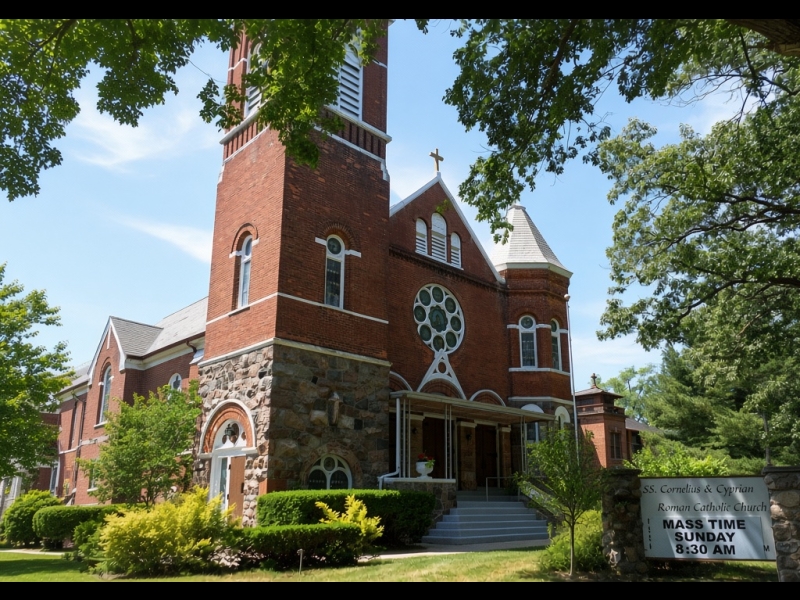
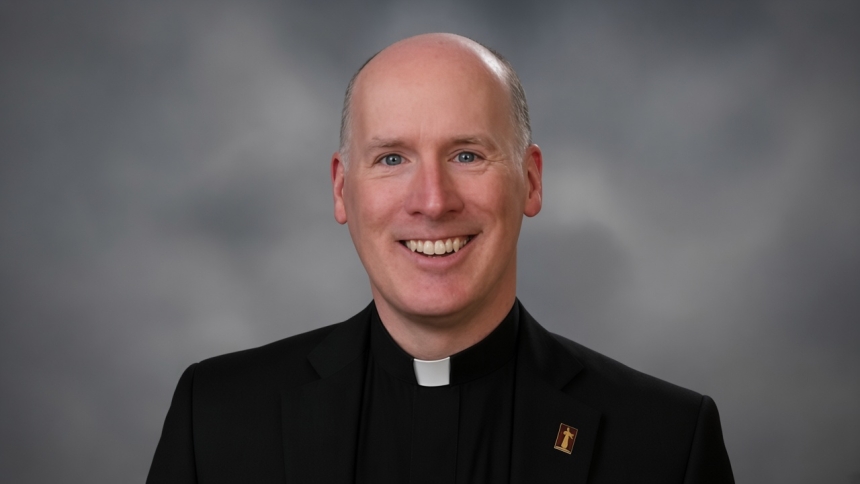
One of the oldest and classically beautiful churches in our diocese is right in the center of Ingham County – at almost the center point of our diocese – on Catholic Church Road, Leslie. The current structure is almost 120 years old, having been rebuilt in 1907 after a fire. It is named for two great martyrs of the 3rd century, Saints Cornelius and Cyprian. Writes Father Gordon Reigle, pictured above, newly installed pastor of the aforementioned parish, pictured below, in conjunction with Saint James in Mason. He continues:
The Roman Empire persecuted Christians formally from 64AD, under Emperor Nero, until the Edict of Milan, under Emperor Constantine the Great, in 313AD. Pope Cornelius was elected in the year 251AD and died in 253AD after being exiled.
If you visit Rome, there are several underground catacombs that you can still tour, and one of the largest and most famous is the Catacomb of Saint Callistus, which was established in the mid-second century and stretches for almost 20 kilometers and spans 5 levels of tombs. This burial ground contains around 16 ancient popes, including Saint Cornelius and Saint Sixtus II, as the lifespan of a third-century pope was not so great.
By tradition, Pope Sixtus II (elected pope in 257AD as the third pope after Cornelius in only 4 years!) went to pray for the dead in one of Rome’s many catacombs with several of his archdeacons one day but was surprised by Roman soldiers and immediately executed along with four of his deacons. One archdeacon of Rome remained, Lawrence, and the Roman prefect demanded that Lawrence bring him the treasures of the Church if his life was to be spared.
Deacon Lawrence immediately distributed the valuables of the Church, giving them to the poor of Rome, and then, three days later, he brought the poor of Rome before the prefect, stating, “Behold the treasure of the Church!” The prefect, not amused, ordered Saint Lawrence to be roasted to death on a gridiron, to which Lawrence quipped with his final words, “Turn me over. I’m done on this side!” These martyrs are all on the Church calendar and still celebrated today as heroes of Rome and the Universal Church.
Saint Sixtus and Companions are celebrated on August 7, and Saint Lawrence, patron saint of cooks (of dark irony), is celebrated three days later on August 10.
I tell this story because this begins a renewed persecution of the Church under Emperor Valerian that ultimately leads to the martyrdom of Saint Cyprian. The Church has preserved a letter from Saint Cyprian that tells of the death of Pope Sixtus II and warns the faithful of the coming persecution. For those who pray the Liturgy of the Hours, that letter is reprinted in the Office of Readings for August 7.
Can you imagine writing to your flock to say that the pope and his archdeacons have been martyred, and the persecutions will soon arrive in your neck of the woods? As Saint Cyprian was the Archbishop of Carthage, which happens to be across the Mediterranean Sea in North Africa, it took 2 years for the persecutions to arrive on his shores and claim his life in 258AD.
These holy martyrs – from Saint Cornelius to Saint Sixtus and Companions to Saint Cyprian – reveal a glorious heroism and witness to the Resurrection under extraordinary pressure. May we be so inspired by their example and the examples of martyrs throughout the centuries! Seeking first the Kingdom isn’t just a worn Christian expression; it is our number one mission and priority, even over life itself. Let us pray for the grace to give the witness of our lives, no matter what comes our way.
Saints Cornelius and Cyprian, pray for us!