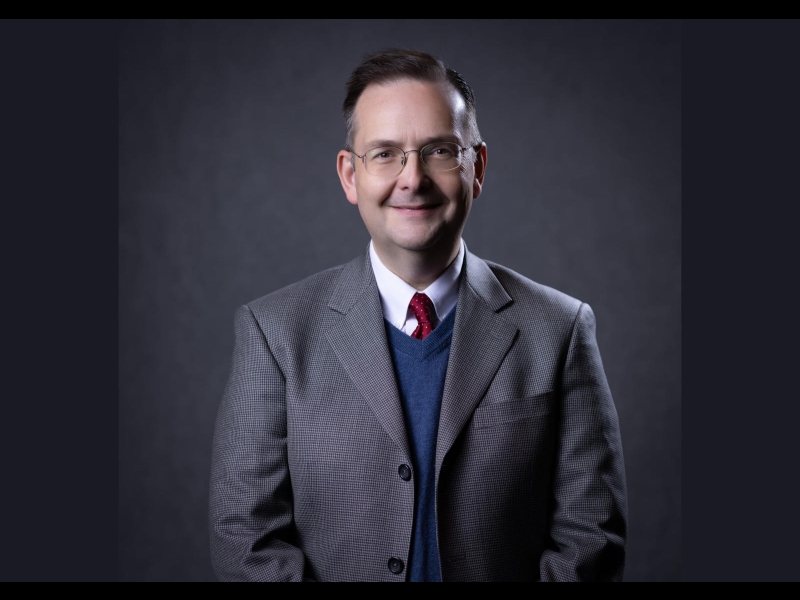

Saint Leo the Great was a man whose abilities, character, and cooperation with divine grace were more than equal to the challenges of his times. In the entire history of the Church, he is one of only two popes (the other is Saint Gregory the Great) to be named a Doctor of the Church, writes Michael Andrews, pictured below, Chancellor of the Diocese of Lansing, November 10.
Of his theological work, perhaps his most important contribution is the famous Tome of Leo. The heretic Eutyches and the Monophysites taught that Christ’s human nature was absorbed into his divine nature. The Council of Chalcedon gathered in AD 451 to reaffirm the true teachings handed on from the Apostles. Over five hundred bishops examined and evaluated numerous theological works. The Tome of Leo, however, stood out as the clearest and most faithful expression of Christian teaching, affirming that our Lord Jesus Christ is true God and true man, possessing two distinct natures, human and divine, unmixed and unconfused, united in one divine person. In keeping with what had been handed down in Sacred Scripture and apostolic tradition, Leo understood that because Jesus is fully God and fully human, he is able to reconcile us to God and heal and redeem our fallen humanity. This truth led the bishops to affirm in one voice: “This is the faith of the fathers! This is the faith of the Apostles! What Leo believes, we all believe! Anathema to him who believes anything else! Peter has spoken through the mouth of Leo!”
All Italy turned to Leo the Great when Attila the Hun ravaged Europe. When Attila, called “the scourge of God,” invaded Italy in 452, Leo went to meet him. It is said that Attila had a vision of the Apostles, Saints Peter and Paul, swords in hand, threatening him if he dared to destroy the city of Rome - a scene later immortalized in a fresco by Raphael. Three years after this encounter, Leo persuaded the Vandal leader Genseric not to subject Rome to fire and slaughter. Remembered as the “Doctor of the Unity of the Church,” Pope Saint Leo the Great now rests beneath an altar dedicated to his memory in Saint Peter’s Basilica. Above this altar stands a magnificent high relief marble sculpture commemorating his meeting with Attila, with Saints Peter and Paul appearing in the heavens above.
Of his nearly 100 surviving sermons and 130 letters, the following lines from Pope Saint Leo the Great’s Christmas sermon stand among his most memorable: "Christian, recognize your dignity and, now that you share in God's own nature, do not return to your former base condition by sinning. Remember who is your head and of whose body you are a member. Never forget that you have been rescued from the power of darkness and brought into the light of the Kingdom of God."