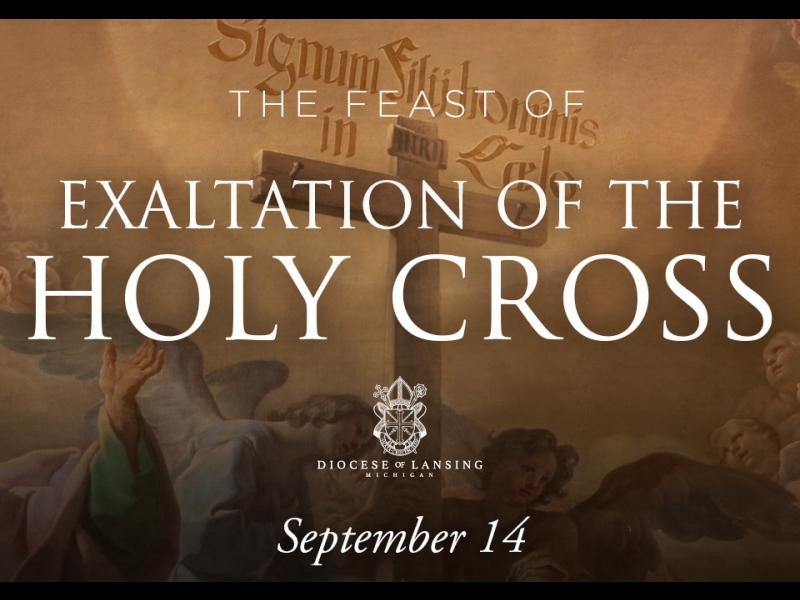

The Cross of Christ is a lie and anyone who looks to the Cross for life has fallen victim to the great lie of Christianity — or so thought the 19th century German philosopher, Friedrich Nietzsche, writes Jeremy Priest, pictured, Director of the Diocese of Lansing's Office of Worship upon the Feast of the Exaltation of the Holy Cross, September 14. Jeremy continues, I once heard a Christian pastor explain that his place of worship didn’t have a Cross in it because there were too many symbols of death in this world.
Christians seem to think that love is the meaning of life and something of the sentiment seems to survive — “All You Need Is Love” (The Beatles). Yet, the truth that love is the meaning of life, that love is the origin from which man buds forth and the end toward which the universe and each person in it is tending, is hardly self-evident.
The universe seems to teach otherwise: galaxies grow further apart; emptiness fills the universe; our Sun will stop shining; the earth is growing old; resources are dwindling; people go hungry, starve, are starved; addiction runs rampant; murder; rape; slavery; abortion; hatred; violence.
Every one of us is dying.
So, where is love in all this?
In the face of such evil, how can we believe in the love we think we’ve seen? In his 1960 play, The Jewelers Shop, the future Pope Saint John Paul II has an exasperated Adam exclaim to Anna, who has lost any sense of love in her marriage, “Ah, Anna, how am I to prove to you that on the other side of all those loves that fill our lives – there is Love?” (64). How, indeed?
Admittedly, the depiction of the Cross is rare in the archeological record of the first few centuries of Christianity — it was just too horrible to behold! Nevertheless, the making of the Sign of the Cross was not rare in Christian life. Indeed, the second-century writer, Tertullian, tells us that “we make the sign of the cross on our foreheads at every turn, at our going in or coming out of the house, while dressing, while putting on our shoes, when we are taking a bath, before and after meals, when we light the lamps, when we go to bed or sit down, and in all the ordinary actions of daily life.” (De Corona, 3.4)
For Nietzsche, the Cross depicted that which “is more harmful than any vice”—that is, “active sympathy for the ill-constituted and weak—Christianity.” As he saw it, this was the antithesis of life. The Cross was the sign of all that was weak and abhorrent in the world.
Yet, for Tertullian and for any who read the Gospels, the Cross shows forth something else entirely: that in our deepest loneliness, our most abject weakness, ugliness; at our most unlovable; at the depth of human wretchedness, where it seems like perhaps there’s no point to existing at all, we are loved and wanted. Indeed, we are necessary to Someone! As Joseph Ratzinger, later Pope Benedict XVI, puts it, what “was for Nietzsche the most detestable expression of the negative character of the Christian religion” — the Cross — “is in truth the centre of the evangelium, the glad tidings: ‘It is good that you exist’—no, ‘It is necessary that you exist.’”
God shows His Love through the Cross (see John 3:16). This is why the Cross and the Altar stand at the center of every Catholic Church. It’s no wonder that every four weeks, at the first glimpse of the sunrise on Sunday morning, the Church sings, “See how the cross of the Lord stands revealed as the tree of life” (Office of Readings, Week I). Touched by this love, Saint Paul exclaims: “I have been crucified with Christ. It is no longer I who live, but Christ who lives in me. And the life I now live in the flesh I live by faith in the Son of God, who loved me and gave himself for me” (Gal 2:20; cf. Gal 6:14). In perhaps the most eloquent description of this love, Saint Paul writes,
“For while we were still weak, at the right time Christ died for the ungodly. For one will scarcely die for a righteous man—though perhaps for a good man one would dare even to die— but God shows his love for us in that while we were yet sinners, Christ died for us.” (Romans 5:6–8)
On this feast of the Exaltation of the Holy Cross, the Church once again turns toward the Father, and through the mediation of Jesus Christ, Priest and Victim, praises the Father for the Work His Son:
For you placed the salvation of the human race on the wood of the Cross, so that, where death arose, life might again spring forth and the evil one, who conquered on a tree, might likewise on a tree be conquered through Christ our Lord.
May the Lord give us eyes to “See how the cross of the Lord stands revealed as the tree of life”!