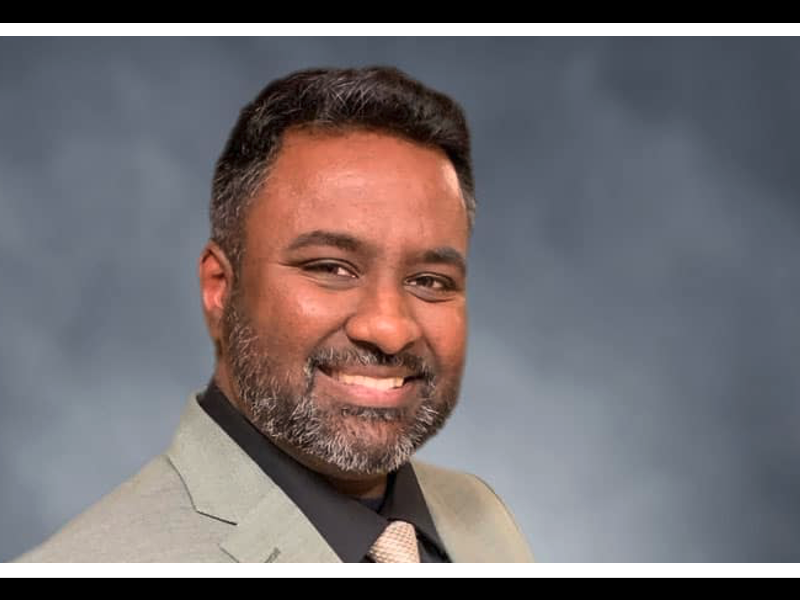
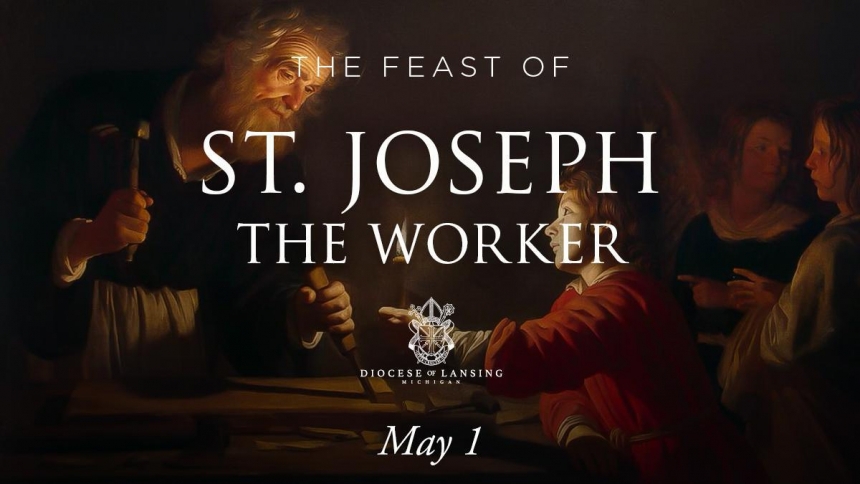
On the Feast of St. Joseph the Worker, May 1, the Church contemplates the holy silence of the man who taught the Son of God how to labor with human hands and to live a covenant life, writes Dr. Marcus Peter, pictured below, Chairman of the Diocese of Lansing's Commission on Catholic Social Teaching. For our Lord, Joseph’s workshop in Nazareth was a school of discipline, provision, obedience and love. Joseph did his work as a God-given vocation, and he ordered it all toward the good of his family.
St. Joseph is a model for the Church’s social magisterium because Catholic social doctrine, through Pope Leo XIII, taught in his encyclical Rerum Novarum (RN) that the worker’s labor must be treated with justice because “each one has a natural right to procure what is required in order to live” (RN 44). Joseph embodied this as a living witness in his life as both tekton (i.e., a craftsman, artisan or builder) and faithful son of the covenant. Joseph worked diligently, guarded Mary and Jesus with his life and showed that man’s labor is ordered to holiness when it serves family and the natural order God has placed in creation.
Therefore, May 1 is a day for Catholics to remember that Christ entered the world of workers, learned from a worker and sanctified human labor from within the home of a just man: his earthly father. Pope St. John Paul II wrote in his third encyclical Laborem Exercens (LE) that “work is a fundamental dimension of man’s existence on earth,” and that “the basis for determining the value of human work is not primarily the kind of work being done but the fact that the one who is doing it is a person” (LE 4, 6).
St. Joseph the Worker reminds the Church that every father who labors honestly and relentlessly, every mother who sacrifices her life for her family daily, alongside every craftsman, teacher, farmer, builder and employee is called to their work by Almighty God, Who uses that work as a means of sanctifying both their souls and all of society. The Catholic Christian is the only person who can see that the human person is made for God and that even his labor is taken up in the life of grace for the sanctification of all mankind.
* Dr. Marcus Peter, a former atheist turned Assemblies of God preacher who entered the Catholic Church in 2010. He is currently president of the Ann Arbor-based Ave Maria Communications, host of Ave Maria in the Afternoon, chair of the Diocese of Lansing's Commission on Catholic Social Teaching, and a biblical scholar with a doctorate from Pontifex University, dedicated to evangelization and Sacred Scripture.