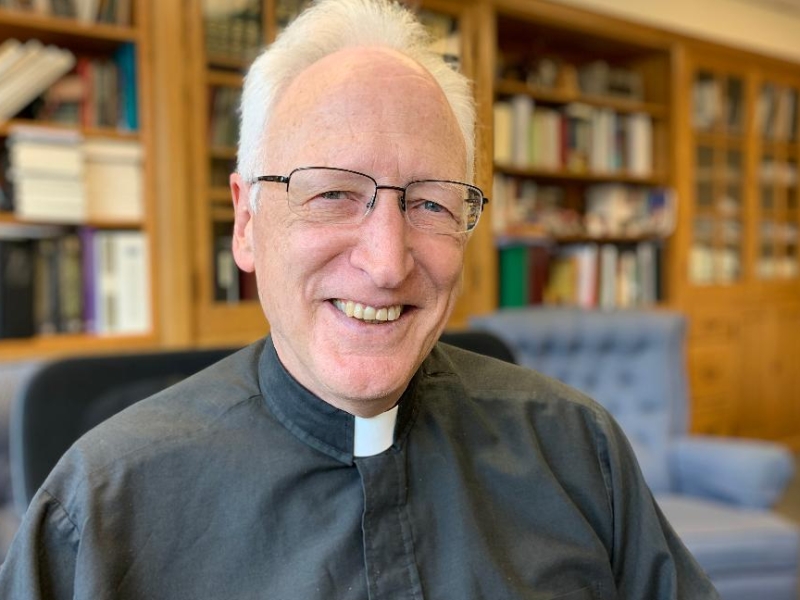

Joseph, a Jew from the Island of Cyprus in the eastern Mediterranean Sea, was living in Jerusalem probably with his sister Mary and his nephew John Mark, writes Bishop Earl Boyea of Lansing upon the Feast of Saint Barnabas, June 11. He must have heard Peter preaching on the feast day of Pentecost because he soon came to believe that Jesus, the crucified one, was the long-awaited Messiah.
This Joseph then sold some of his property and very generously gave the proceeds to the apostles for the care of the followers of Jesus. Perhaps that is why the apostles called him, “Barnabas,” or “Son of Encouragement” (Acts 4:36). The Greek word for this encouragement is paraklesis. So, Barnabas was a paraclete, an encourager.
At the Last Supper, Jesus was aware of how desolate his apostles would be the next day, the day of His crucifixion and death. So, Jesus four times promises to send them the Paraclete (John 14:16, 26; 15:26; 16:7). This term, paraclete, is often interpreted in a legal sense to mean that the Holy Spirit will be our lawyer. But that is too narrow of an understanding. Rather, this Holy Paraclete is someone Who walks with us and encourages us.
Perhaps, we can look at how Barnabas was a paraclete to the early Church, to his nephew, and even to St. Paul, to understand more clearly how the Holy Spirit is the Paraclete to all of us.
Let’s start with Paul. Paul has changed from arresting and imprisoning followers of Jesus, even helping with the execution of Stephen, to being now a follower of Jesus himself. After this change, which took place while he was on his way to Damascus in Syria in order to arrest more Christians, Paul returned to Jerusalem a different man. Nonetheless, he scared all the Jewish-Christians in the city and caused a lot of turmoil, because they didn’t believe that he had really changed. But Barnabas defended Paul and walked with him during his brief stay in the Holy City.
Besides being generous in support of the Church in Jerusalem, Barnabas, 10 years later, was sent to get first-hand knowledge of the growing community of Jewish and Gentile Christians in Antioch (Acts 11:22). He was delighted with what he saw and so he encouraged them, we are told, “for he was a good man, full of the Holy Spirit and of faith” (Acts11:24). Seeing great needs for these new Christians, Barnabas then went next door to Tarsus, Paul’s hometown, where Paul had been side-lined for these past 10 years, and brought Paul to Antioch to use his great talents to build up the faithful.
Finally, Barnabas and Paul were sent by the Church in Antioch on a great missionary journey to Cyprus, Barnabas’ home, and then on to southern Turkey. Barnabas’ nephew John Mark accompanied them, but bailed for some reason when they got to Turkey (Acts 13:13). Paul did not like this abandonment. So, when they were later ready to revisit the churches that they had established in Turkey, Barnabas wanted to give his nephew a second chance, but Paul said no way, and so they split up, Barnabas taking John Mark back to Cyprus (Acts 15:36-39).
Barnabas is a model for us on how to be a paraclete to others: to be a companion, an encourager, a supporter, a second-chancer to all we meet.