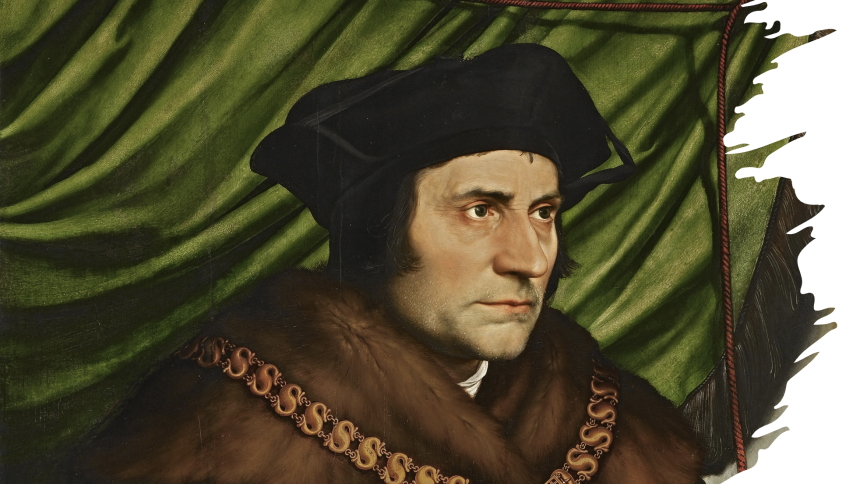
In 1527, renowned Renaissance artist Hans Holbein the Younger completed his portrait of the martyred chancellor of England, one of the world’s most inspiring and revered paintings — Portrait of Sir Thomas More, writes Joseph Pronechen in the National Catholic Register, February 20, 2026.
To commemorate this quincentennial, the Lansing Catholic Lawyers Guild in Michigan has commissioned one of this country’s finest sacred artists to paint a new portrait of More.
The idea began with William Bloomfield, general counsel of the Diocese of Lansing and president of the guild. The group always displayed a print of the Holbein portrait at their functions. Bloomfield suggested commissioning a new, updated oil-painted portrait of the martyr More. The guild agreed.
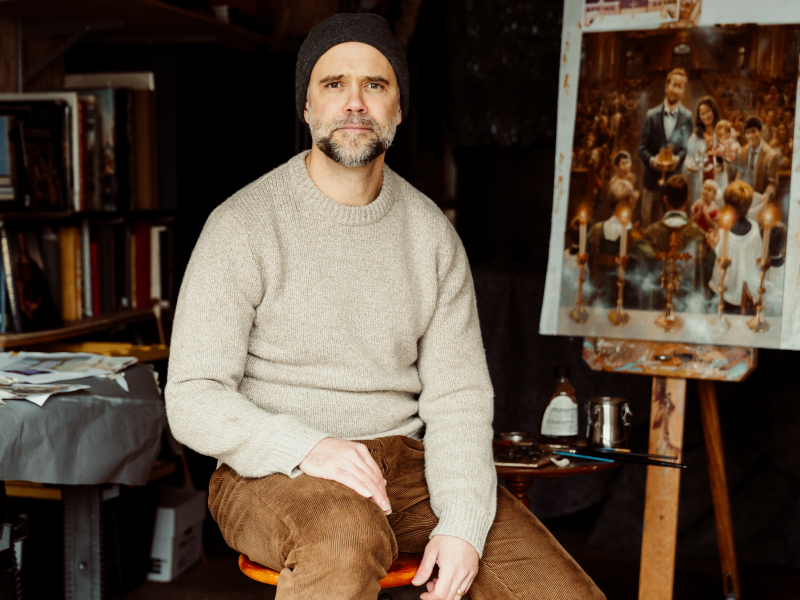
Artist Joseph Macklin, pictured below, was their immediate choice, as he was not only based in the Diocese of Lansing, but had just completed an outstanding major mural that received national attention. Called The Cosmological Vision of Holy Mass, that artwork fills the apse of St. John the Evangelist Church in Jackson.
Macklin is happy to take on this new project, as he is quite familiar with the original portrait depicting More’s thoughtful gaze and realistic appearance, even down to his whiskers.
“Early on, while studying fine art with an emphasis on painting techniques, I came across Hans Holbein the Younger’s portrait of St. Thomas More,” Macklin explained. “The image seared a standard into my mind not only for Holbein the Younger’s precision of color, depth of skin tone, form, smooth surface texture, but also the stalwartness expressed in the sitter, St. Thomas More.”
From his Instrumentum Dei Studio, he told the Register, “I’m really excited about the opportunity to take on this project and honor Our Lord to the best of my ability and with fidelity, trying to create a new painting.”
New Vision
His vision for this Holbein-inspired project has begun. “Because of the standard that exists from Hans Holbein, it’s important for me to recognize that standard,” he explained. “The way for me to best do that, and I feel called to do, is to honor that portrait and basically put myself as if I was working alongside Hans Holbein the Younger in the position of an apprentice.”
For one, he will study in person the original famous painting now part of The Frick Collection in Manhattan. He will also study another Holbein portrait in an Ohio museum.
Macklin said he intends to emulate the techniques of the five-century-old master.
“[T]he surface of his paintings are so smooth in such a thin paint application — the technique is called indirect glazing,” he noted, as contrasted with direct oil painting of famous artists who created surfaces that were very, very thick and really dense. “Hans Holbein is practically the opposite.”
Macklin envisages a front-facing portrait, “not in the three-quarters profile that you see in Hans Holbein, but probably to paint him directly, as if we were sitting in front of him. He would be looking directly at us or at the viewer.”
But the saint’s visage will harken to that famous depiction.
The 42-year-old artist surmises “it’s likely or probable that this is the only painting of St. Thomas More that was painted with St. Thomas More sitting there while it was being painted, at least for some of the time that it was being painted. And being as exceptional a painter as Hans Holbein the Younger was, we can assume that in that portrait he’s not far off with how St. Thomas More looked.”
But the artist also pointed to some appropriate changes for this portrait, in his view, “because this is no longer St. Thomas More when he was working directly with King Henry VIII. In that famous portrait, you see the Esses livery chain [a centuries-old emblem of service to the king] and the Tudor rose. But St. Thomas More [later] gave up that position as chancellor of Henry VIII.”
Consequently, Macklin would like his portrait to show that chain with either “a broken link or resting on a table in front of Thomas More.” It would still reflect the techniques Holbein, who was supported by More during his first visit to London, often implemented, “like a table in front of the sitter with a book resting on it.” These changes would “be indicating that this is clearly a portrait that’s been painted since he took that chain off,” Macklin explained.
Macklin’s plans to bring in More’s attire “to really respect the integrity of the clothing that Hans Holbein incorporated. We can see with his clothing that there are velvet sleeves, a little bit more of a satin, and then fur.” Macklin believes he will “probably try to stick pretty close to the original,” adding that he is “not sure if the colors will change.” He will research to see if certain colors might point to More’s position under Henry at the time. His goal is to make sure that he is not adjusting “in a way that detracts from the depth or the quality that this painting needs to have.”
The artist brings out a fascinating detail not seen in Hans Holbein the Younger’s portrait of More “because it was painted at a time when he’s very much alive. He is without a halo.” Since saints’ portraits often include halos, Macklin will likely consider one of some kind, making a family connection artistically.
“I love the work by Hans Holbein the Elder. The Younger’s father was a very gifted artist who oftentimes produced work that was very Catholic in nature. Hans Holbein the Elder has a lot of beautiful sacred artwork. So it’s quite possible that I may incorporate a halo that at least resembles or is pulled from some of the halo details or work that his father produced and incorporated into his work to show some of that lineage.”
And Macklin — who studied fine art at the Columbus College of Art and Design in Ohio and previously taught high-school graphic design for 13 years — is also considering the inclusion of a primary sacramental.
Holbein the Younger’s portrait of The Ambassadors includes a crucifix partially revealed and hanging on green drapery that “really underscores our faith or our Catholic identity and faith,” Macklin said, saying he is discerning “if anything like that makes it into this final painting.”
Something else is essential to him for this painting. “As I’ve been doing this work, I find it very important to relinquish the sense of artistic ego,” he explained. “I work very hard to follow tradition that has been put forth by artists that have lived well before me. And we’re producing some beautiful, beautiful work to honor and give glory to God. So, for me, it’s important that I don’t strive to produce ‘a Joseph Macklin.’ It’s not about me. It’s about honoring the project that has been laid forth to really recognize and attribute the beautiful patron saint of lawyers, in this case, St. Thomas More. What better way to do that than to follow tradition.”
Speaking of tradition, when Bloomfield saw the beautiful traditional-style oil painting of St. Gerard Majella the artist did for a local parish, he called it “incredible,” adding: “We’ve got somebody within our diocese that is painting in the style of the Old Masters that I was seeing in world-renowned museums.”
Praying one day, he felt inspired to suggest hiring Macklin to do this painting of St. Thomas More for the guild. With today’s challenges to religious freedom and marriage, “St. Thomas More is an exemplar of what it means to be a Catholic lawyer,” Bloomfield said.
“Now is the time to draw even more and renew attention to Thomas More. He’s an inspiration to us all. And the time is right for a new piece of art that cultivates devotion to this great saint and promotes the ideals of holiness and religious liberty.”
Bloomfield calls Macklin “a true Catholic artist. This is a man who prays and who even fasts — a true Catholic whose faith is manifested in his art. That’s why we want Joe Macklin to do this painting.”
Though the painting has not yet begun, once completed, the artwork will be placed in the crypt of St. Mary Cathedral in Lansing and used for the Lawyers Guild’s monthly First Friday Masses and be prominent at the guild’s annual Red Mass and annual St. Thomas More Award.
For his part, Macklin said that, with the Holy Spirit as his guide, he looks forward to painting a portrait honoring More’s “traits that arrested me those years ago.”
Looking ahead, he said, “My hope is that it certainly resembles the Holbein, that the look that he captured has that stalwartness, that gaze from St. Thomas More. It’s almost like he’d be peering directly out at the other person; that look, that gaze of ‘I’m guided by the Spirit; I’m guided by my faith,’ is searing. I hope that that comes through in this new painting; and in the end, that it looks like a painting that was done by somebody who was close to Hans Holbein — even if I’m 500 years removed.”
• The cost to complete the Saint Thomas More portrait project is $40,000. Would you like to contribute for this great work of art to commemorate the Guild of Catholic Lawyer’s patron? Donations are tax-deductible. For more information contact William Bloomfield, President of the Catholic Lawyers Guild, at wbloomfield@dioceseoflansing.org. Online donations may be made to the Guild here.